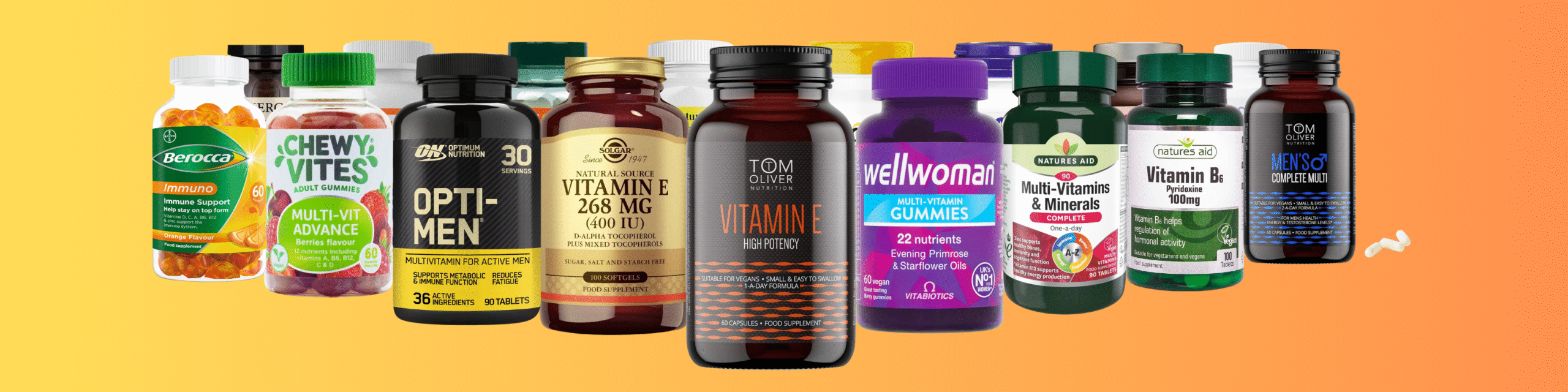
Everything you need to know before buying vitamins or supplements. If you cannot find what you are looking for here, head over to the Contact page and drop us a message.
1. How do I choose the right vitamin or multivitamin for me?
This is the right question to start with, because buying the wrong supplement is surprisingly easy in a market flooded with products making similar-sounding claims. The honest answer is that the right choice depends on your diet, your lifestyle, your age, and whether you have any specific nutritional gaps worth addressing.
For general health maintenance, a broad-spectrum daily multivitamin can be a practical way to fill dietary gaps without needing to take multiple individual supplements. Look for one that covers the key micronutrients at or close to the UK Nutrient Reference Values (NRVs) rather than megadoses of a few selected vitamins.
For immune support, Vitamin C, Vitamin D, and Zinc are among the most widely researched nutrients in this area. Vitamin D deserves particular attention for UK adults — the NHS recommends that everyone in the UK consider a daily Vitamin D supplement during autumn and winter due to limited sunlight exposure.
For energy and tiredness, the B vitamin complex — particularly B12, B6, and folate — is nutritionally associated with normal energy metabolism and the reduction of tiredness and fatigue.
For bone health, Calcium and Vitamin D work together to support normal bone maintenance. Magnesium also plays an important role that is often overlooked in this context.
For specific life stages, needs vary considerably. Pregnant women are advised by the NHS to take folic acid and Vitamin D throughout pregnancy. Vegans and vegetarians may benefit from B12, iron, omega-3, and iodine supplementation due to dietary restrictions. Older adults often require higher levels of Vitamin D, B12, and Calcium as absorption efficiency decreases with age.
If you are unsure where to start, our Vitamins Buying Guide offers a plain-language breakdown before you look at individual products.
2. Are the supplements you review personally tested?
Not in a laboratory sense, no — and being upfront about that matters. What every review on this site is built on is thorough, methodical research: carefully analysing ingredient lists and dosages, studying verified customer feedback, consulting clinical literature, and drawing on expert nutritional sources from across the web.
Particular attention goes to the form of each nutrient used in a product — because this affects how well the body can actually absorb and use it. Magnesium citrate, for example, is considerably better absorbed than magnesium oxide, yet both appear on labels without distinction. These are the kinds of details that matter in a real-world review and that I look for in every product assessed on this site.
If a supplement has underdosed ingredients, unnecessary fillers, or a pattern of negative long-term customer feedback, you will find that clearly reflected in the review.
3. Is it safe to buy vitamins and supplements through Amazon UK?
For most UK buyers, yes — Amazon is a reliable and convenient place to purchase supplements, provided you take a few sensible precautions.
Most products are covered by a 30-day return policy, and purchases made through third-party sellers are protected by the Amazon A-to-Z Guarantee, which ensures you either receive the item as described or get your money back.
That said, the supplement category attracts more low-quality and misleading products than most. Before buying, always check that the product clearly lists its full ingredient profile and exact dosages per serving. Look for supplements carrying recognised quality markers such as GMP certification (Good Manufacturing Practice), which indicates consistent manufacturing standards. Be sceptical of any listing making dramatic health claims — responsible UK supplement brands are legally required to stay within strict boundaries on what they can claim.
All purchases through Amazon UK are also covered by your statutory rights under the Consumer Rights Act 2015, providing protection beyond Amazon’s own policies.
Always consult your GP or a qualified healthcare professional before starting any new supplement, particularly if you take prescribed medication or have an existing health condition.
4. What are the benefits of buying vitamins from Amazon UK?
There are several practical reasons why Amazon is a strong choice for supplement purchases. The selection is extensive — from well-established brands like Solgar, Holland & Barrett, and Nature’s Best to smaller specialist producers, far more is available in one place than most high street shops carry. Pricing is generally competitive, with supplements frequently appearing in promotional deals and Subscribe & Save options that reduce the cost of regular purchases.
Verified customer reviews on Amazon, when read carefully, provide genuinely useful insight into real-world experience over time. Fast and reliable delivery, including next-day options on many products, adds further convenience.
One practical tip: always check whether the listing is sold directly by Amazon or fulfilled by Amazon rather than an unknown third-party seller. For supplements especially, provenance and storage conditions matter — buying from a reputable source reduces the risk of receiving counterfeit or improperly stored products.
5. What is the difference between a multivitamin and individual vitamin supplements?
This is a genuinely useful distinction to understand before spending your money, because the right choice depends entirely on your situation.
A multivitamin combines multiple vitamins and minerals in a single daily dose. It is a practical and cost-effective option for people who want broad nutritional coverage without the complexity of managing multiple separate supplements. The trade-off is that a multivitamin may not provide any single nutrient at a therapeutically meaningful dose — it covers a wide range at moderate levels rather than targeting specific needs deeply.
Individual vitamin supplements allow you to address specific deficiencies or nutritional goals with greater precision and at higher dosages where appropriate. If a blood test has confirmed you are Vitamin D deficient, for example, a targeted high-dose Vitamin D supplement will be far more effective than the modest amount found in most multivitamins. Similarly, if you are vegan and primarily concerned about B12, a dedicated B12 supplement in the methylcobalamin form — which is better absorbed than the cheaper cyanocobalamin — makes more sense than a multivitamin.
For many adults, a practical approach is to take a quality multivitamin as a nutritional foundation and add one or two targeted individual supplements where specific needs have been identified — ideally following a conversation with a GP or registered nutritionist.
6. What do the percentages on supplement labels actually mean?
This confuses a lot of buyers and is worth understanding properly. The percentage figure shown next to each nutrient on a supplement label refers to the Nutrient Reference Value (NRV) — the standard used across the UK and EU that indicates what proportion of an average adult’s daily requirement that dose provides.
A supplement showing 100% NRV for Vitamin C means one serving provides the full daily reference amount. Some supplements exceed 100% NRV significantly, which is not necessarily a problem for water-soluble vitamins like Vitamin C and the B vitamins, as excess is generally excreted by the body. For fat-soluble vitamins like Vitamin A, Vitamin D, Vitamin E, and Vitamin K, which are stored in the body, consistently exceeding recommended levels can be harmful over time.
The NHS provides clear guidance on safe upper limits for individual vitamins and minerals, which is worth consulting if you are considering high-dose supplementation.
7. Are vitamins and supplements regulated in the UK?
Yes, though the regulatory framework is worth understanding. In the UK, vitamins and food supplements are regulated by the Food Standards Agency (FSA) rather than the Medicines and Healthcare products Regulatory Agency, which oversees pharmaceutical drugs. This means they do not need to prove efficacy before being sold — only that they are safe for consumption and accurately labelled.
Supplements cannot legally claim to treat, prevent, or cure any medical condition. Any product making such claims on Amazon or elsewhere is operating outside the law. On this site, all benefit-related statements are framed as what nutritional science generally associates with a nutrient, or what customers report experiencing — never as medical fact.
If you see a supplement carrying a Traditional Herbal Registration (THR) licence, it has been assessed for safety and quality by the MHRA, which is a meaningful quality indicator.
8. Can I take vitamins alongside prescription medication?
This is an important question and one where caution is genuinely warranted. Always consult your GP or a qualified pharmacist before combining supplements with prescribed medication.
Some interactions are well documented. High-dose Vitamin E and fish oil can affect blood clotting and may interact with anticoagulants like warfarin. Calcium can interfere with the absorption of certain antibiotics and thyroid medications if taken at the same time. Even seemingly harmless supplements like Vitamin D at high doses can cause problems for people with certain medical conditions.
The NHS has useful guidance on vitamins and medication interactions that is worth reviewing. Nothing on this site constitutes medical advice, and no review should be taken as a recommendation to replace or adjust prescribed medical treatment.
9. How long does it take for vitamins to make a difference?
This varies depending on the nutrient, the individual, and the severity of any underlying deficiency. There is no universal answer, but here is a practical guide based on what customers commonly report and what nutritional research generally suggests.
Vitamin D at therapeutic doses for confirmed deficiency can produce measurable improvements in blood levels within four to six weeks, though some people report noticing improvements in energy and mood sooner. B12 supplementation for those who are deficient may produce noticeable energy improvements within a few weeks of consistent use. Magnesium is reported by many users to produce noticeable effects on sleep quality and muscle comfort within two to four weeks. Iron supplementation for confirmed deficiency typically takes several weeks to months to meaningfully restore levels, with GP monitoring recommended throughout.
For general maintenance supplementation where no significant deficiency exists, effects are often subtle and gradual. Throughout the reviews on this site, I reference what real customers report about their experience over time, which is often the most useful indicator of realistic expectations.
10. Do your links earn you a commission?
Yes, and I want to be completely transparent about that. Most product links on this site are Amazon affiliate links, which means I earn a small commission if you make a purchase through them. This comes at absolutely no extra cost to you — the price you pay is exactly the same whether you arrive via this site or go to Amazon directly.
These commissions are what make it possible to keep this site running and the content free. They do not influence which products I recommend or how I review them. If a supplement has weak dosages, poor quality ingredients, or does not live up to its claims based on real customer feedback, I will say so clearly. Honest, trustworthy reviews are the only reason this site exists.
Still have a question?
If there is something not covered here, head over to the Contact page and drop us a message. I read everything and aim to respond within 24 to 48 hours, Monday through Friday.